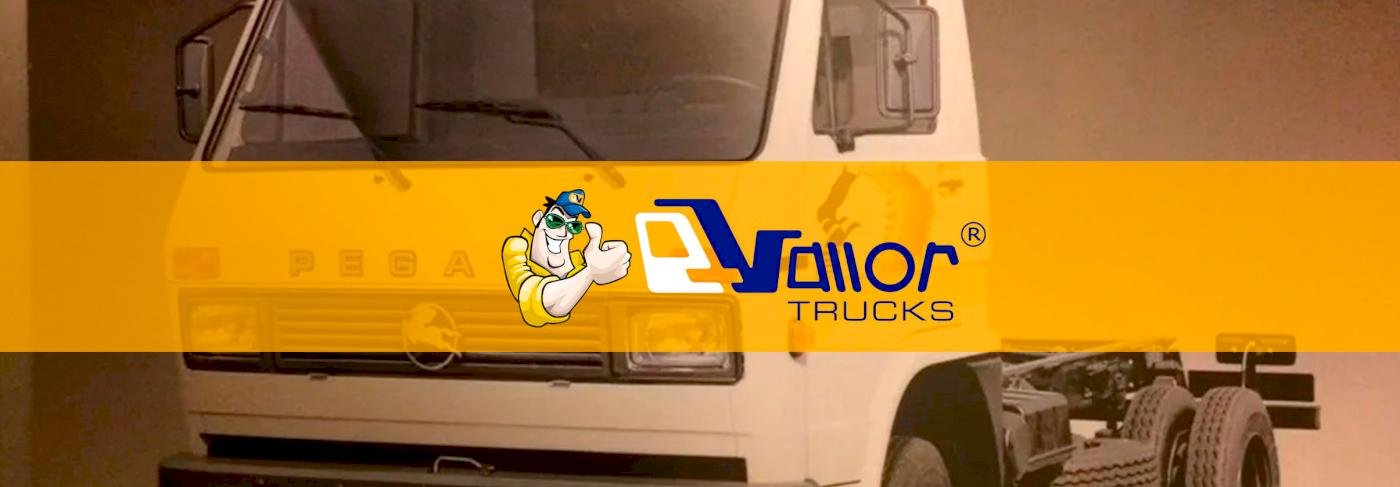






Today on Vallor Trucks, we’re looking back at the EGYPTIAN PEGASUS…
In 1984, Pegaso (ENASA) decided to compete in the “toughest rally in the world” at the wheel of an Egyptian PEGASO 3046 Pegaso. This vehicle was fitted with a Pegaso 9100.42 engine with a displacement of 10,170 cc and producing 170 cv; most of these vehicles were used as forest fire engines for companies such as Firmeas, Abenco, Pefipresa and Protec Fire. These vehicles are so robust that many of them are still in service at numerous fire stations.
Returning to the Dakar Rally, in its sixth edition, this legendary Pegaso 3046/10, popularly known as the “Egyptian” —with hardly any modifications and driven by Carlos del Val and Miguel Guerrero—finished eighth in its category and was one of only twelve lorries to complete the race that year. Interestingly, upon finishing, the driver refused to let the vehicle be shipped back to Spain and decided to drive it home himself. This result led to the creation of an official team for the following years. Pegaso’s strategy was to field lorries weighing under 10 tonnes with engines producing around 200 CV; this gave them an advantage on rough terrain and in challenging sections.
For the 1985 season, Carlos del Val won the “Rally of the Pharaohs”; the team had two PEGASO 3046 and 7222 cars. By 1988, they had unveiled the “Proto” or Pegaso 7223, which had been developed on the basis of a Pegaso 7222. This new variant featured a modified engine position over the rear axle and produced 225CV; with this change, the weight distribution was 50 per cent on each axle, thereby improving the car’s stability and traction. It was able to “tackle” obstacles and jumps with greater confidence due to the reduced load on the front axle, resulting from the lower forces it had to bear. The transmission was also modified to a 6-speed system, and interchangeable drive shafts were fitted, sending 60 per cent of the torque to the front axle and the remaining 40 per cent to the rear. As the cab no longer housed the engine, space was made for a third crew member, and additional supports were fitted to enhance rigidity. In short, this Pegaso Proto had a kerb weight of 8,500 kg.
Finally, the Pegaso 7227 appeared as an evolution of the “Proto” with a 270Cv mid-engine, to which an automatic gearbox was added. Another interesting fact is that the “Egyptian” Pegasos took part as support vehicles for other teams.