




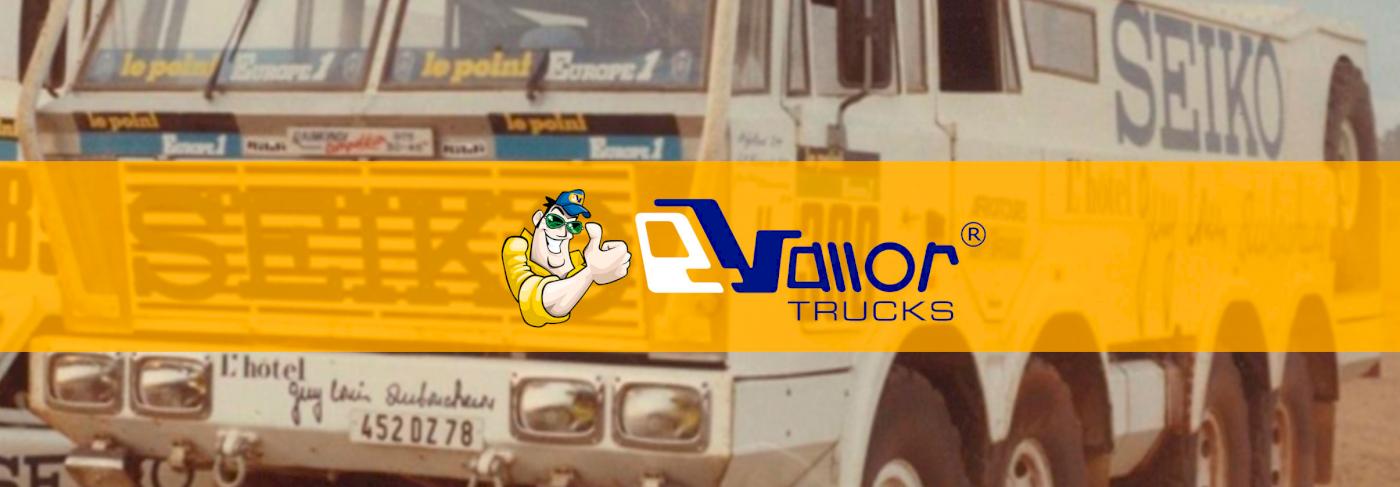
At the 1982 Dakar Rally, Seiko, in collaboration with L’Hôtel Guy-Louis Duboucheron, commissioned Jean-Louis Raimondi’s workshops to build an impressive 8×8 truck.
The Seiko Proto was built on the basis of American M-35 military lorries (manufactured from 1950 onwards by Reo, Kaiser and Studebaker). These lorries originally had a 6×6 configuration, so it was necessary to cut, adapt and join two M-35 chassis to build the prototype. The original 130CV inline-six engine was replaced by a Deutz V8 diesel engine supercharged by two KKK turbochargers, delivering 350 CV at 2,400 rpm. The engine remained in its original position above the front axles, behind the driver’s and co-driver’s seats. To transfer all this power to the ground, a 6-speed ZF sequential gearbox was fitted. The suspension was also upgraded by adding single-acting shock absorbers to the leaf springs.
A monocoque body was fitted to this new chassis, consisting of a square steel tube frame covered with polyester panels, with a total length of 9.12 m; despite its enormous overhangs, it had good approach (45°) and departure (35°). The front overhang housed the four-door cabin with two rows of seats, whilst the rear overhang accommodated the spare wheels. The central-rear section was a comfortable lounge where stage winners were treated to champagne and gourmet dinners and invited to spend the night as part of the team’s publicity strategy. It was also equipped with a shower, a real luxury in those early Dakar rallies. It is said that on one occasion the truck had to be refuelled by aeroplane, and the team took the opportunity to order a few crates of fresh oysters.
On 1 January 1982, the Seiko Proto 8×8 No. 389, driven by Allain Galland, Jean-Louis Raimondi and the hotelier Guy-Louis Duboucheron, set off on the 4th edition of the Paris-Dakar. The gearbox bearings deteriorated rapidly and their failure forced the Seiko Proto to retire during the seventh stage between Gao and Mopti. Of the rest of the Seiko team, only the Cotel Buggy No. 140, finishing in 48th place, and the Toyota BJ No. 343, finishing in 69th place, completed the race. The Seiko Proto returned to Jean-Louis Raimondi’s workshops on the outskirts of Paris, where it was left parked in the open for several years until it was reportedly destroyed by fire, although accounts of the truck’s fate are unclear. Some say it was rescued by Allain Gallard and ended its days refurbished and converted into an off-road bus in Morocco (where it was photographed in December 2005), others say that this bus is a second prototype with a slightly different body, whilst some even speculate that it could be a conversion inspired by the Seiko Proto, built on a 4-axle construction lorry chassis. The only thing on which all accounts agree is that the Seiko Proto 8×8 has not survived to the present day.
Remember that at Vallor Trucks you’ll find the lorry you’re looking for; we have a wide range in stock: